Preventive vs predictive maintenance is the budget question every UAE plant manager faces after the first costly breakdown. Heat, dust and humidity wear equipment faster here, so the wrong approach either wastes money or leaves critical assets exposed. This guide compares both strategies, shows where each pays back and explains how to reduce unplanned downtime without overspending. It draws on the engineering experience of General Tech Automation, a UAE automation engineering company with 28+ years of industrial heritage.
Preventive vs Predictive Maintenance: The Core Difference
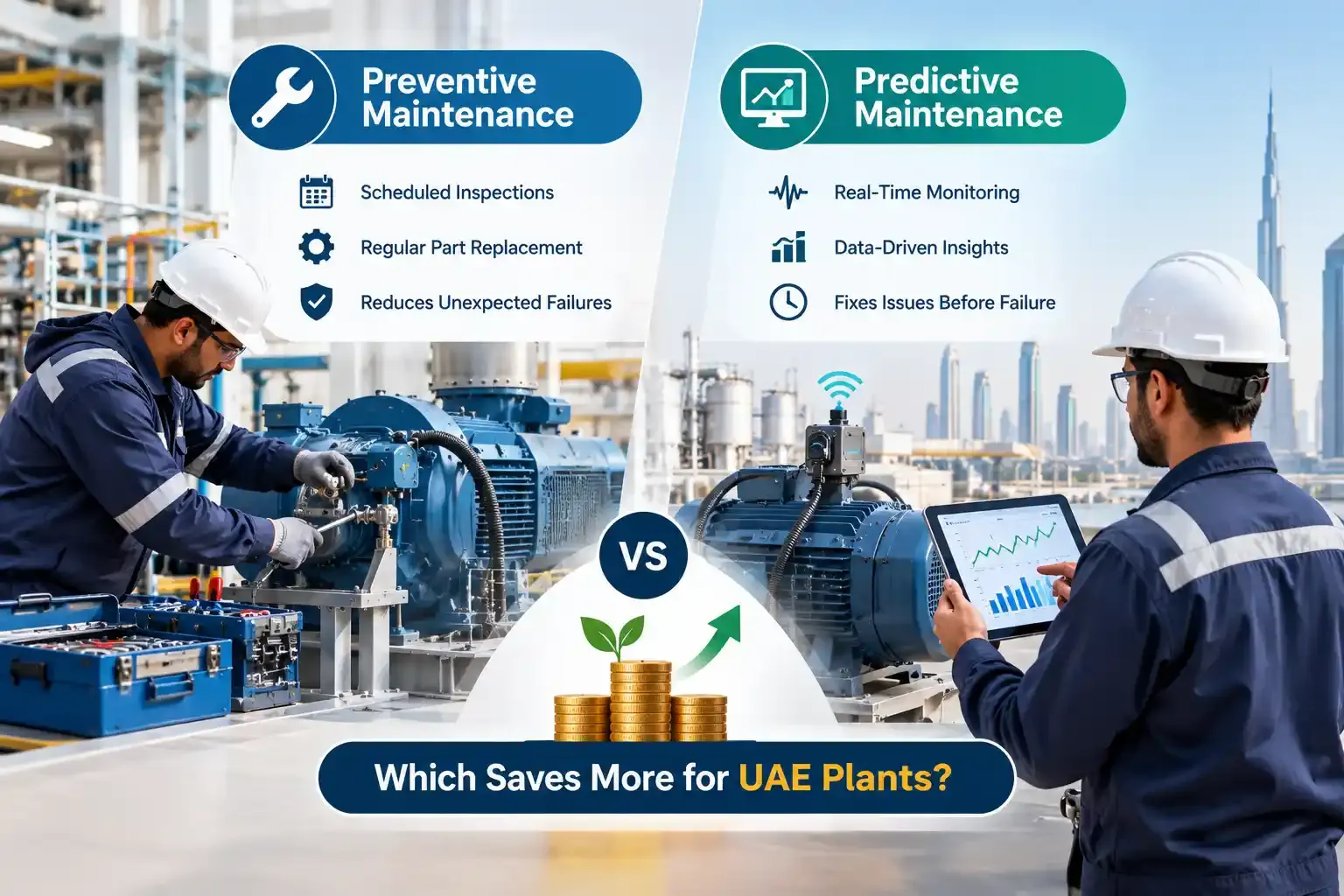
Preventive maintenance is time- or usage-based. You service equipment at fixed intervals, whether or not it shows a problem. A preventive maintenance schedule might call for quarterly panel inspections or annual drive cleaning.
Predictive maintenance is condition-based. You act when data shows a fault developing. Predictive maintenance UAE plants adopt usually relies on condition monitoring for industrial plants, tracking vibration, temperature, current and other signals.
In one line, preventive maintenance asks “how long has it been?” while predictive maintenance asks “what is the equipment telling us?” That distinction drives every cost and benefit below.
How Preventive Maintenance Works in Practice
A good preventive maintenance schedule is simple, repeatable and easy to audit. It works best where wear is predictable.
Where It Performs Well
- Filters, belts, lubrication and cooling fans
- Cleaning and tightening in control panels
- Safety checks and compliance inspections
- Assets with a known, consistent wear pattern
Where It Falls Short
- Healthy equipment gets serviced anyway, wasting labour and parts
- Random failures between visits still happen
- Intervals copied from a manual may not suit UAE conditions
- Every intervention carries a small risk of human error
How Predictive Maintenance Works in Practice
Predictive maintenance replaces the calendar with evidence. Three tools do most of the work.
Industrial IoT Sensors for Maintenance
Industrial IoT sensors for maintenance measure temperature, vibration, current and runtime, then send the data to a dashboard. Alerts trigger when readings drift from normal. General Tech Automation’s industrial IoT services cover sensors, gateways and cloud connectivity for this purpose.
Thermal Imaging of Control Panels
Thermal imaging of control panels reveals hot spots from loose terminations, overloaded breakers and failing contactors. These faults often look normal until they fail. A thermal scan can be done on a live panel, so production does not stop.
VFD and Servo Drive Maintenance
VFD and servo drive maintenance benefits strongly from monitoring. Drive temperature, load, fan condition and fault history show early wear. Catching a failing fan or capacitor in time can avoid a long outage and an expensive repair. For budgeting, see our guide to servo drive repair cost in the UAE.
Preventive vs Predictive Maintenance: Cost Comparison
The preventive vs predictive maintenance cost question has no universal winner. Each strategy moves cost to a different place.
FactorPreventivePredictive
Upfront cost
Low
Higher (sensors, software, skills)
Running cost
Steady, calendar-driven
Lower once tuned
Wasted servicing
Common
Rare
Catches random faults
Poorly
Well
Best for
Predictable wear
Critical, costly assets
Maintenance cost reduction comes from matching the method to the asset. Predictive monitoring costs more to set up, but it avoids needless servicing and catastrophic failure. Preventive work costs less to start, but it can over-maintain healthy equipment and miss sudden faults.
Which Strategy Saves More? Decide by Asset Type
Use asset criticality to decide, not preference.
- Critical, expensive or slow-to-replace assets: large drives, main panels, key motors. Choose predictive monitoring.
- Predictable wear items: filters, belts, lubrication. Choose a preventive schedule.
- Low-cost, non-critical items: run to failure may be the cheapest option.
Ask one question per asset: what does an hour of failure cost compared with the cost of monitoring it? When the answer is high, monitor.
Why UAE Conditions Change the Equation
Local conditions make the preventive vs predictive maintenance choice more urgent. Ambient heat pushes panels and drives closer to their limits. Dust clogs filters faster. Humidity and coastal air accelerate corrosion in Sharjah, Ajman and Fujairah.
As a result, intervals taken from a generic manual can be too long. Condition data lets you adjust to your actual site rather than a textbook average.
Build a Hybrid Plan That Cuts Downtime
Most plants get the best return from a hybrid. The preventive vs predictive maintenance debate then becomes a question of proportion, not of choosing one. A practical sequence:
- Rank assets by criticality and failure cost
- Set a baseline preventive maintenance schedule for all assets
- Add monitoring to the top tier of critical equipment
- Record history so decisions improve over time
- Review every quarter and adjust intervals
Step 4 matters more than most teams expect. Good records show which assets fail, how often and why. Our asset data management services help plants keep drawings, tag history and records in one place, which turns raw data into decisions.
Use an Annual Maintenance Contract UAE Plants Can Plan Around
An annual maintenance contract UAE sites sign can combine both strategies under one plan. Scheduled inspections cover the preventive work, while condition checks catch developing faults early. Priority engineering support then shortens recovery when something does fail.
General Tech Automation’s AMC services for panels, VFD, UPS and servo drives follow this preventive model, with engineers based in the UAE. This approach helps plants reduce unplanned downtime while keeping budgets predictable.
Frequently Asked Questions
Is preventive vs predictive maintenance an either-or choice?
No. Most plants use both. Preventive work covers predictable wear, while predictive monitoring protects critical assets where failure is costly.
Does predictive maintenance always cost more?
Upfront, usually yes, because of sensors, software and training. Over time it can lower costs by avoiding unnecessary servicing and major failures, but the return depends on how critical the asset is.
What should a small plant start with?
Start with a solid preventive schedule and a thermal imaging survey of control panels. Then add monitoring to the one or two assets that would hurt most if they failed.
How do I know my current schedule is wrong?
Look for repeat failures between visits, or for parts replaced while still in good condition. Both signal that intervals do not match real conditions.
Conclusion
Preventive vs predictive maintenance is not a contest with one winner. Preventive servicing is the foundation, and predictive monitoring protects the assets you cannot afford to lose. Rank your equipment, monitor the critical few and keep good records. That mix delivers the best maintenance cost reduction for most UAE plants.