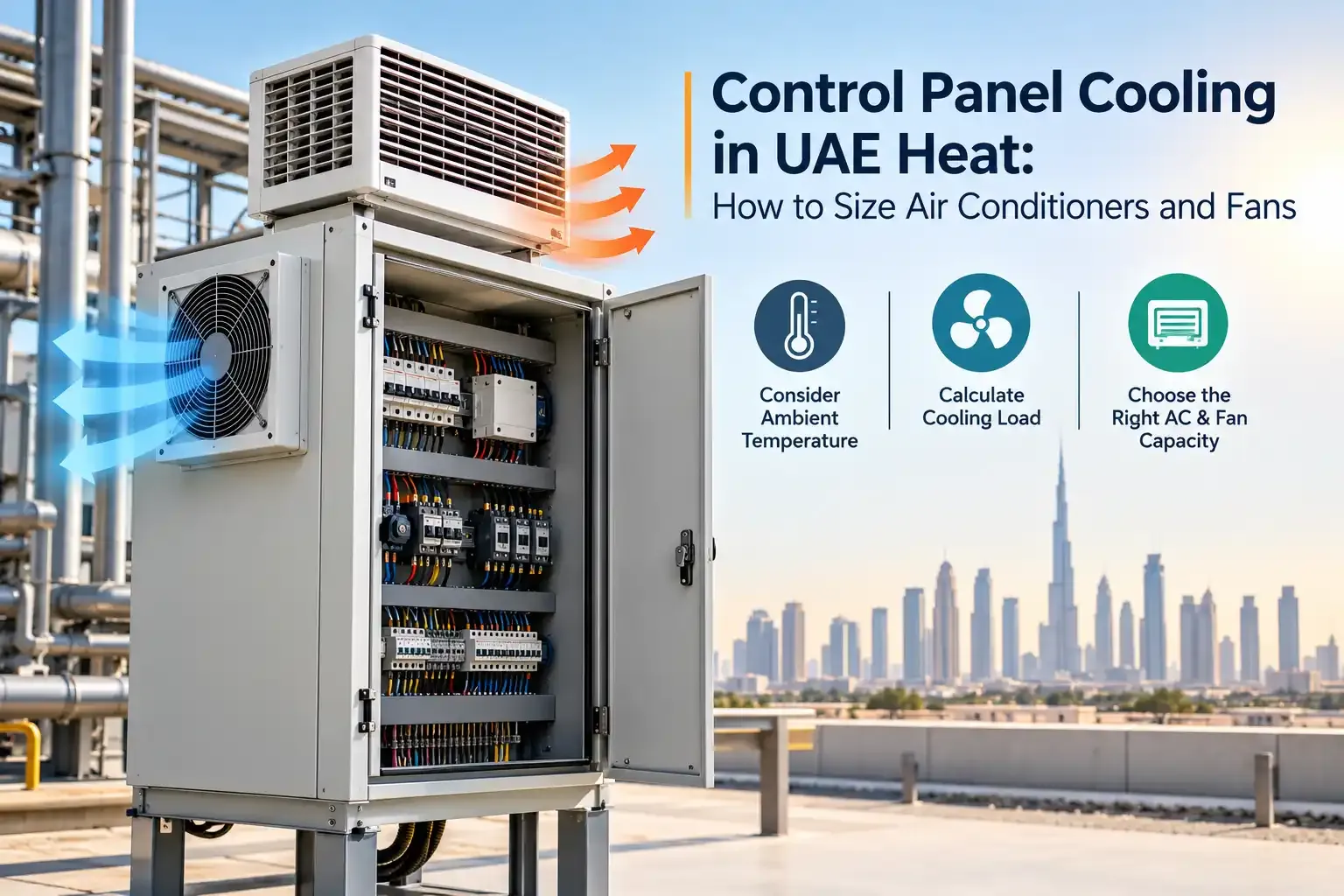
Control panel cooling decides whether your PLCs and drives survive a UAE summer or trip out in July. When ambient air reaches 45–50°C, a panel that looked perfect on the drawing can overheat its own electronics. Dust-clogged filters, sun-heated enclosures and tightly packed VFDs make the problem worse.
This guide helps plant managers, maintenance and controls engineers, panel builders and MEP/EPC contractors size air conditioners and fans with confidence. You will learn the heat load method, how to choose between fans and AC, and how to avoid costly mistakes. At General Tech Automation, we see the same failure patterns across Dubai, Sharjah and Abu Dhabi, so the advice below reflects real plant conditions.
Why Control Panel Cooling Matters at 45–50°C Ambient
Heat shortens electronics life. A widely used rule of thumb says component life roughly halves for every 10°C above its rated temperature. In a UAE plant, that rule bites hard.
Weak control panel cooling usually shows up as:
- Nuisance VFD trips and unexplained drive derating
- PLC resets, communication drops and erratic I/O
- Discoloured terminals and loose connections from thermal cycling
- Early failure of power supplies and capacitors
Control Panel Temperature Rise Limits vs UAE Reality
Standard assembly design assumes a maximum ambient of +40°C and a 24-hour average of +35°C. UAE summers exceed both. So control panel temperature rise limits must be checked against real site conditions, not catalogue defaults. Our guide to IEC 61439 compliance for UAE contractors explains how temperature rise verification works.
Most drive and PLC datasheets allow roughly 40–55°C inside the enclosure. Above that, drives derate their output. Always design to the most sensitive device in the panel.
Control Panel Heat Load Calculation: Start Here
Every control panel cooling decision starts with a control panel heat load calculation. Skip it and you are guessing. Follow these steps:
- List internal heat (Qv). Add the watt losses of every VFD, soft starter, power supply, contactor, transformer and PLC rack. As a quick check, a drive typically loses about 2–4% of its rated power as heat.
- Find the exposed surface area (A). Include every side that exchanges heat with the room air.
- Set the target internal temperature (Ti). Use the lowest device limit, commonly 35–40°C.
- Use the highest realistic ambient (Tu). Take 50°C, and add an allowance if the enclosure sits in direct sun.
- Calculate external heat gain (Qs). In the UAE, Tu exceeds Ti, so the enclosure absorbs heat: Qs = k × A × (Tu − Ti). Use k ≈ 5.5 W/m²K for painted sheet steel.
Total cooling needed: Qe = Qv + Qs. Then add a 15–25% margin for dust, ageing and future expansion.
Control Panel Air Conditioner Sizing: A Worked Example
Accurate control panel air conditioner sizing prevents both undersized and oversized units. Consider a free-standing VFD panel:
- Internal losses: 1,800 W
- Exposed surface area: 4.5 m²
- Target internal temperature: 40°C; site ambient: 50°C
- External heat gain: 5.5 × 4.5 × 10 ≈ 248 W
- Subtotal: about 2,050 W; with 20% margin: roughly 2,460 W
A 2.5 kW class unit is the right starting point. However, check the supplier’s capacity curve at your real conditions. Many catalogue ratings quote 35°C ambient, so output at 50°C is lower.
Avoid grossly oversized units, too. They short-cycle, wear faster and dehumidify poorly. Right-sized control panel cooling runs steadily and keeps temperature stable.
Control Panel Cooling Fans and Filters: When They Work
Fans are cheap and simple, but they only remove heat when outside air is cooler than your internal target. The approximate airflow needed is V = 3.1 × Qv ÷ (Ti − Tu) m³/h at sea level.
Notice the problem. At 50°C ambient, Ti − Tu is negative, so a fan simply pushes hot air through the panel. Fans still make sense in air-conditioned electrical rooms, in winter, or where ambient stays below about 30°C.
When you rely on control panel cooling fans and filters, apply these rules:
- Fit an exhaust filter equal in size to the intake filter
- Place the intake low and the exhaust high to use natural convection
- Choose filter media rated for fine desert dust
- Clean or replace filters monthly at dusty sites
Panel AC Unit for High Ambient Temperature
When ambient exceeds your internal limit, only refrigeration works. Choose a panel AC unit for high ambient temperature that is rated for continuous duty at 50°C or above. Look for:
- Cooling capacity published at your actual ambient and setpoint
- Corrosion-protected condenser coils for coastal or humid sites
- Condensate management (evaporation or drain)
- A thermostat setpoint near 35–40°C to avoid condensation
- An alarm contact wired to your PLC or SCADA
IP54 / IP65 Enclosure Cooling Solutions
Your control panel cooling method must protect the enclosure’s ingress rating. Compare the main IP54 / IP65 enclosure cooling solutions:
OptionBest forLimitation
Fan and filter
Cool ambient, indoor rooms
Typically IP54 at best; filters clog
Sealed panel AC
45–50°C ambient, dusty areas
Higher cost, needs condensate care
Air-to-air heat exchanger
Dusty sites with moderate ambient
Ambient must be below internal temperature
Air-to-water exchanger
Plants with chilled water
Needs a reliable water loop
For most outdoor or semi-outdoor UAE panels, a sealed closed-loop AC is the safest choice.
VFD Panel Overheating Prevention
Drives produce the most heat in any panel, so VFD panel overheating prevention deserves its own checklist. Effective control panel cooling begins with good layout:
- Keep the manufacturer’s clearances above and below each drive
- Use baffles to stop hot exhaust air recirculating
- Consider through-panel mounting so heatsinks sit outside the sealed zone
- Check derating curves for altitude, temperature and switching frequency
- Add a temperature sensor with an early-warning alarm
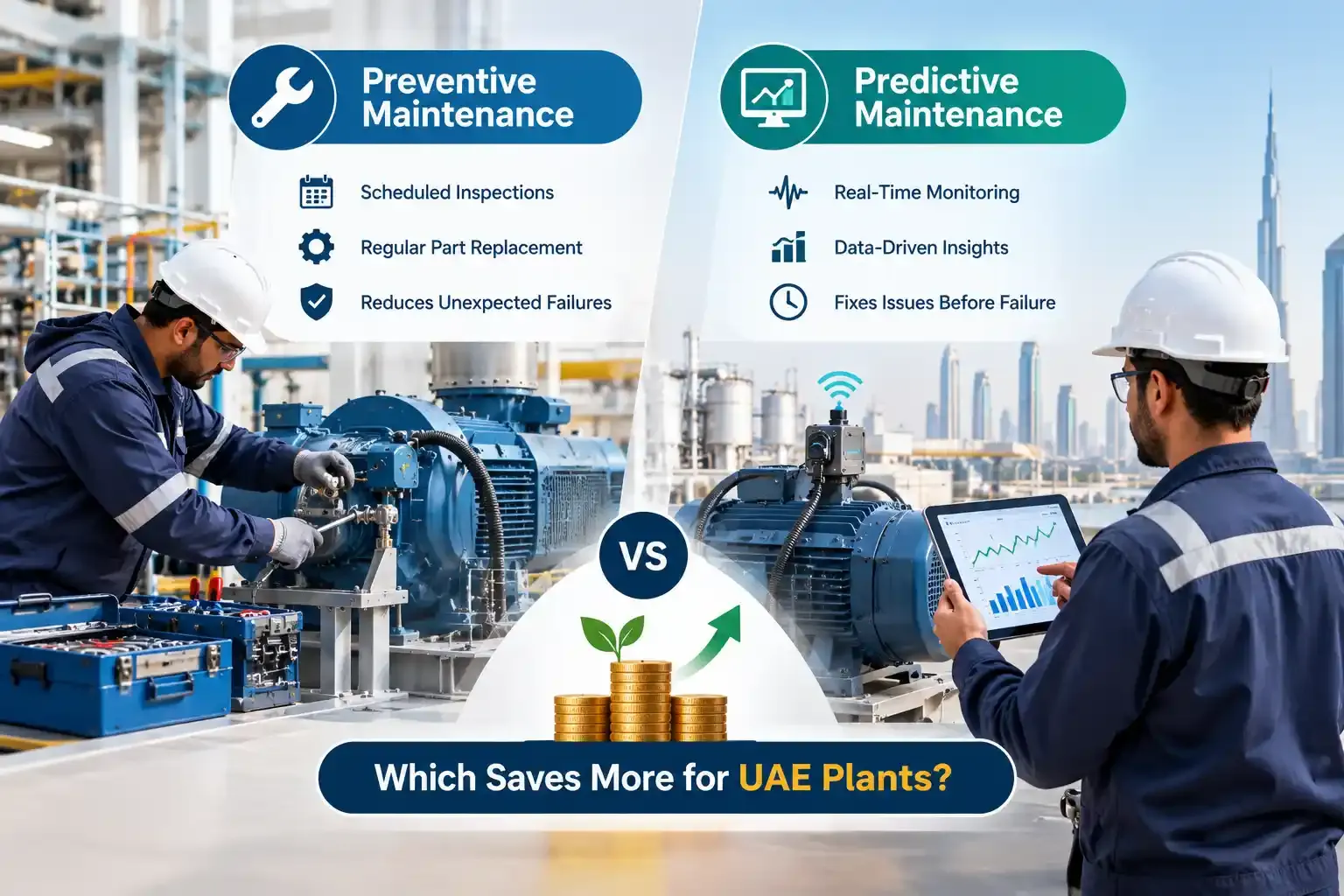
Furthermore, schedule thermal imaging during inspections. Our comparison of preventive vs predictive maintenance in UAE plants shows how thermal checks catch hot spots before they cause downtime.
Electrical Enclosure Cooling UAE: Site Factors That Change the Answer
Electrical enclosure cooling UAE projects face conditions that catalogues rarely cover, so control panel cooling must be designed for local heat, dust and humidity:
- Solar gain: Shade canopies and light-coloured paint reduce external heat.
- Fine dust: Sand clogs open filters fast, which favours closed-loop cooling.
- Humidity: Setting the panel too cold invites condensation.
- Salt air: Coastal zones need coated or stainless components.
Treat enclosure thermal management as a system: heat sources, enclosure, cooling unit and maintenance all work together.
Industrial Panel Cooling Sharjah: Design and Maintenance Support
Industrial panel cooling Sharjah customers deal with dust from industrial areas and humidity from the coast. Good enclosure thermal management starts at the design stage, not after the first trip. Our team builds cooling into custom control panel design and manufacturing, so heat load, cooling and clearances are verified before panels reach site.
After commissioning, keep performance steady with AMC services for panels, VFD, UPS and servo drives. Scheduled filter changes, coil cleaning and thermal checks protect your control panel cooling investment year after year.
Frequently Asked Questions
What is the best control panel cooling method for 50°C ambient?
A sealed, closed-loop panel air conditioner is usually best. Fans and heat exchangers cannot cool below ambient, so they fail when outside air is hotter than your internal limit. Good control panel cooling at this temperature always needs refrigeration.
How do I size an air conditioner for a control panel?
Add internal heat losses to external heat gain, then add a 15–25% margin. Compare the result with the unit’s rated capacity at your real ambient and setpoint.
What temperature should a control panel be kept at?
Most targets sit between 35°C and 40°C inside the enclosure. Always follow the lowest limit among your VFDs, PLCs and power supplies.
How often should panel filters and AC units be serviced?
Check filters monthly at dusty UAE sites. Service condensers and condensate drains at least twice a year, or on your AMC schedule.
Conclusion
Strong control panel cooling starts with numbers: heat load, ambient, setpoint and margin. Then choose the right tool. Use sealed AC for UAE heat, and fans only where the air is genuinely cooler. Maintain it, and your drives, PLCs and production stay online.