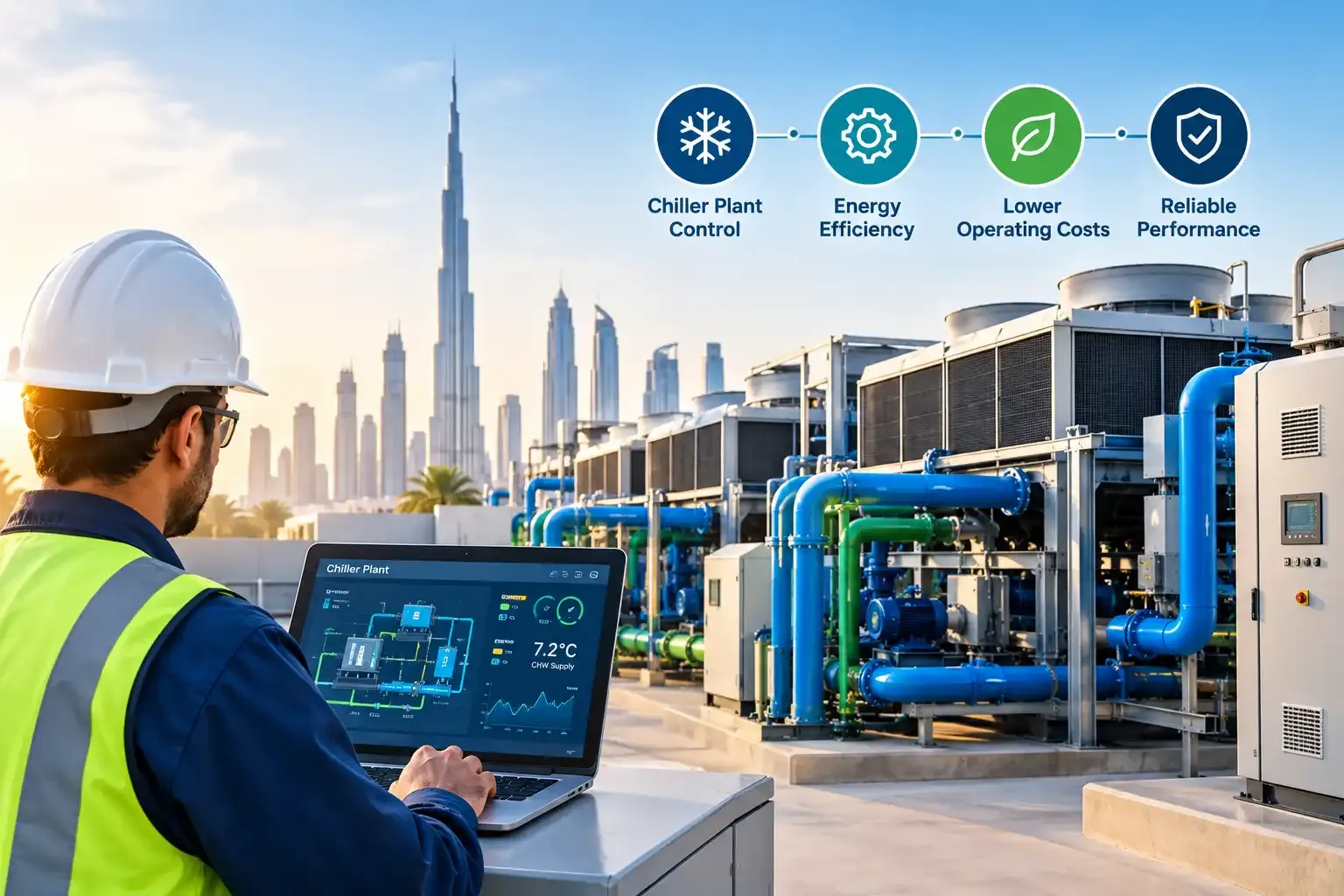
District cooling automation turns a large chilled water network into a system that reacts to real demand instead of fixed schedules. In the UAE, cooling drives a large share of electricity use, so smarter control directly affects operating cost, reliability and sustainability targets.
Many plants still run on aging controls, manual setpoints and disconnected panels. As a result, operators chase alarms, chillers cycle inefficiently and energy bills keep rising. Well-planned district cooling automation addresses these problems at the source. This guide shows facility managers, MEP and controls engineers, and procurement teams how chiller plant automation works, what to specify, and how to get measurable savings.
For a wider view of our capabilities, visit the General Tech Automation home page.
What Is District Cooling Automation?
District cooling automation uses PLCs, SCADA, field instruments and building interfaces to run chillers, pumps, cooling towers and distribution networks as one coordinated plant. Instead of each machine acting alone, a supervisory layer decides which equipment runs, at what load and for how long.
A modern district cooling plant control system typically includes:
- Field instruments: temperature, flow, pressure and energy meters
- Controllers: PLCs or DCS units that execute sequencing and loop control
- Supervisory layer: SCADA servers and operator HMIs for alarms and trends
- Network links: connections to customer buildings and energy transfer stations
- Historian: long-term data storage for analysis and reporting
Together, these layers make chiller plant automation predictable, auditable and easy to maintain.
Key Benefits of District Cooling Automation
- Lower energy use: staging and resets keep chillers near peak efficiency.
- Stable supply: tighter temperature and pressure control across the network.
- Faster fault response: prioritized alarms and remote access cut troubleshooting time.
- Better reporting: trend data supports audits, billing checks and sustainability reporting.
- Longer equipment life: balanced run hours and fewer start-stop cycles reduce wear.
Because these benefits compound, even modest gains in sequencing and delta-T control can noticeably lower plant energy intensity.
Core Elements of a District Cooling Plant Control System
Each layer plays a specific role. The sections below explain how they work together.
PLC-Based Chiller Sequencing
PLC-based chiller sequencing decides when to start, stage and stop chillers as load changes. Good logic accounts for efficiency curves, run-hour balancing, minimum run times and fault fallback. Poor sequencing is a common source of wasted energy, because chillers often operate far from their best efficiency point.
Typical sequencing rules include:
- Start the lead chiller only after a confirmed cooling demand.
- Add a lag chiller when load stays above a defined threshold for a set delay.
- Rotate the lead role to balance run hours.
- Switch automatically to standby equipment after a fault.
Our PLC programming services cover this logic across Siemens, Allen-Bradley, Schneider and Mitsubishi platforms.
SCADA for District Cooling Plants
SCADA for district cooling plants gives operators one view of every chiller, pump, valve and meter. Live dashboards show supply and return temperatures, plant kW/TR and prioritized alarms. Trend data then supports faster troubleshooting and better planning.
We build this layer as part of our PLC, DCS and SCADA automation solutions, with remote monitoring so teams can track the plant from anywhere in the UAE.
BMS Integration for District Cooling
BMS integration for district cooling connects the plant to customer buildings and energy transfer stations. Open protocols such as BACnet and Modbus let the plant read building demand, differential pressure and metering data. Consequently, the plant produces only the cooling the network actually needs.
Chilled Water System Control Strategies That Cut Energy Use
Effective chilled water system control balances stability, comfort and power consumption. Three strategies deliver most of the gain.
Variable Primary Flow Control
Variable primary flow control removes constant-speed primary pumps and lets one set of variable-speed pumps serve both the chillers and the loop. Flow follows demand, so pump energy falls at part load.
However, this approach needs accurate flow measurement, minimum-flow protection and well-tuned bypass valve control. Poor tuning can trip chillers on low flow, so commissioning quality matters.
Delta-T Management
Low delta-T is a classic district cooling problem. When return water comes back too cool, chillers run inefficiently and pumps move more water than necessary. Automation helps through differential pressure reset, valve limiting and alarms that flag the buildings causing the issue.
Setpoint Reset and Cooling Tower Control
Chilled water supply reset, condenser water reset and tower fan control let chillers run at lower lift. In the UAE’s hot, humid climate, tower control has a strong effect on total plant efficiency.
Chiller Plant Optimization UAE: Energy Efficiency in District Cooling
Chiller plant optimization UAE projects must handle long summers, wide load swings and demanding water-treatment conditions. Energy efficiency in district cooling therefore depends on tracking the right metrics:
- Plant kW/TR (total plant efficiency)
- Chilled water delta-T
- Chiller part-load performance
- Pump and cooling tower fan energy
- Thermal storage charge and discharge, where installed
Without trending these values, teams cannot prove savings. A well-built control system logs them continuously, so every change can be verified.
In practice, the first quick wins usually come from fixing sensor drift, retuning control loops and correcting sequencing logic. Hardware replacement tends to come later, if at all. Pairing automation with preventive vs predictive maintenance then protects those gains over time.
Common Mistakes to Avoid in Chiller Plant Automation
Even well-funded projects stumble on the same issues:
- Specifying hardware before defining a control philosophy
- Ignoring sensor calibration, which makes optimization unreliable
- Skipping factory acceptance testing, which moves problems to site
- Leaving documentation incomplete, so future changes become risky
- Treating district cooling automation as a one-time project instead of an ongoing program
Because accurate measurement underpins every control decision, calibrated instruments matter as much as clever logic. General Tech’s instrumentation and calibration heritage helps here.
How to Implement District Cooling Automation Step by Step
A structured approach reduces risk, especially in live plants that cannot stop for long.
- Site audit: review existing controls, instruments and hardware condition.
- Engineering design: define the control philosophy, architecture and panel layout.
- Programming and panel build: write and test logic, and fabricate panels in-house.
- FAT and SAT: validate the system before and after installation.
- Commissioning and tuning: bring the system live with minimal disruption.
- Ongoing support: keep the plant efficient through scheduled service.
Timelines depend on scope. Most projects run from a few weeks for a single plant section to a few months for a full plant, with dates agreed during the site audit.
For operating plants, our industrial retrofit solutions upgrade legacy controllers in phases instead of forcing a full replacement.
Choosing Among District Cooling Automation Companies in UAE
A strong district cooling automation partner is judged by delivery, not brochures. When comparing district cooling automation companies in UAE, ask these questions:
- Can they support multi-vendor platforms such as Siemens, Allen-Bradley, Schneider, ABB and DeltaV?
- Will they hand over as-built drawings, tag lists and program backups?
- Can engineers reach your site within hours?
- Do they run factory and site acceptance tests?
- Do they offer maintenance contracts after go-live?
General Tech Automation is a UAE-based automation engineering specialist backed by General Tech’s industrial heritage since 1998. Every project has one accountable engineer from site visit to handover, and the drawings stay yours.
Frequently Asked Questions About District Cooling Automation
What is district cooling automation?
District cooling automation is the use of controllers, SCADA and instruments to run chillers, pumps and towers as one coordinated system. It improves efficiency, stability and visibility.
How does chiller plant automation reduce energy use?
It stages chillers by actual load, resets setpoints and varies pump and fan speeds. Therefore, equipment runs closer to its best efficiency point.
Is variable primary flow control suitable for existing plants?
Often yes, but it depends on chiller minimum-flow limits, existing valves and instrumentation. A site audit confirms feasibility before design starts.
Which protocols support BMS integration for district cooling?
BACnet and Modbus are the most common, while OPC often links SCADA with other systems. The right choice depends on existing equipment.
How long does a district cooling retrofit take?
It depends on scope. Single sections take a few weeks, while full plants take a few months.
Start Your District Cooling Automation Project
Reliable district cooling automation lowers energy use, cuts downtime and gives operators clear control of every chiller. Start with a site audit, fix the basics first and build toward full optimization.