Industrial automation ROI is the clearest way to prove that a control system upgrade is an investment, not an expense. Yet many UAE plants delay upgrades because the payback feels hard to measure.
Ageing PLCs, obsolete SCADA and scarce spare parts quietly drain budgets through stoppages, rework and emergency repairs. This guide shows plant managers, operations heads and finance teams how to calculate industrial automation ROI with real numbers, so the decision is easy to defend.
To see the engineering team behind these upgrades, visit the General Tech Automation home page.
What Industrial Automation ROI Really Measures
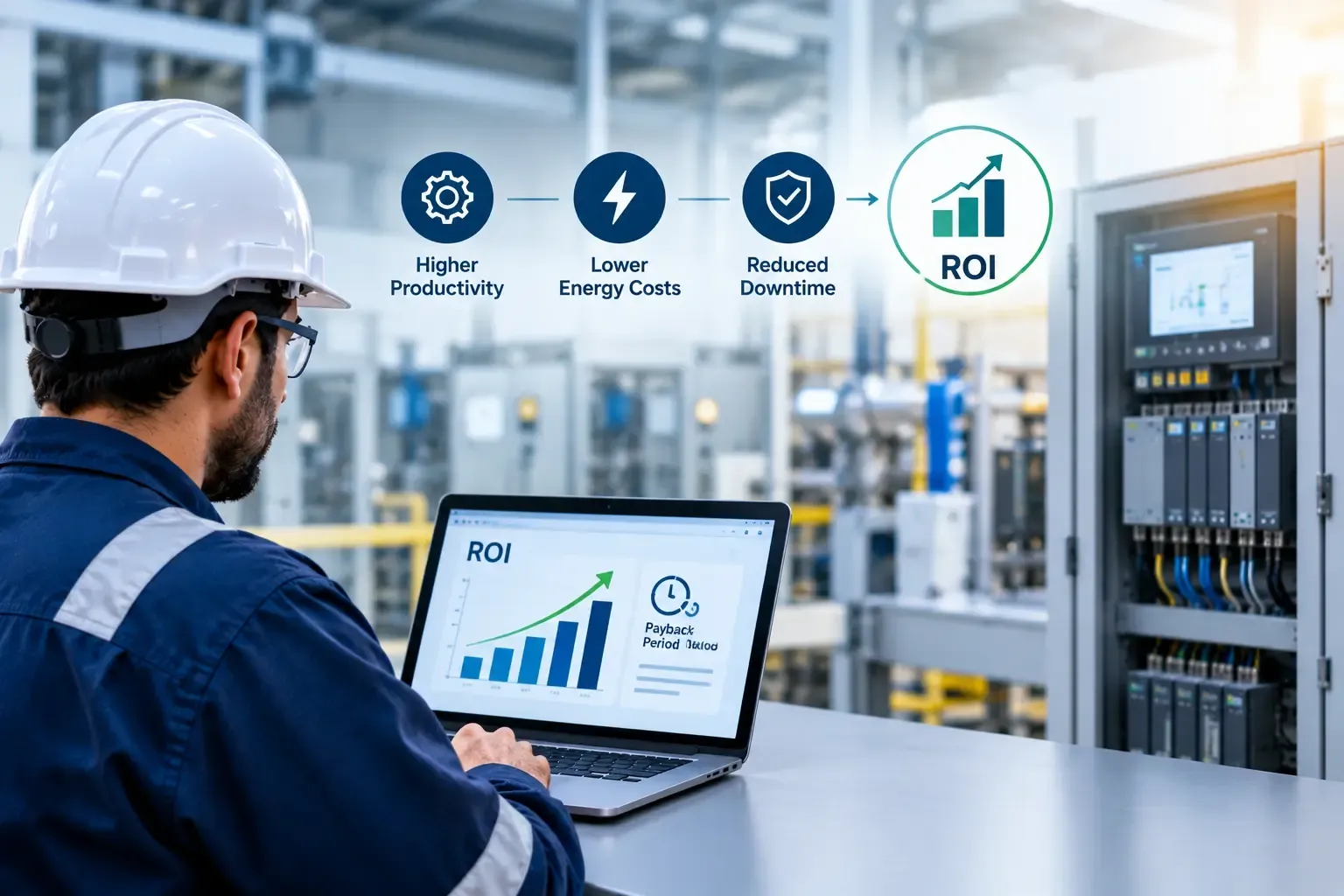
Industrial automation ROI compares the net financial gain from an upgrade with its total cost. It goes beyond purchase price and includes the savings that start once the new system runs.
Two metrics matter most:
- ROI: net gain divided by investment cost, shown as a percentage
- Payback period: the time needed for savings to repay the investment
A control system upgrade payback period is usually the figure finance teams approve first, because it shows how quickly cash returns.
How to Calculate Automation ROI Step by Step
Knowing how to calculate automation ROI starts with a simple, repeatable formula:
- Payback period = total upgrade cost ÷ annual net savings
- ROI (%) = (total savings over period − upgrade cost) ÷ upgrade cost × 100
Step 1: Build the Industrial Automation Cost-Benefit Analysis
An industrial automation cost-benefit analysis lists every cost and every gain over a fixed period, usually three to five years. Include both one-time and recurring items.
Typical costs:
- Hardware: controllers, I/O, drives, panels and network gear
- Engineering: design, programming, testing and documentation
- Installation and commissioning, including planned shutdown time
- Training for operators and maintenance staff
Typical gains:
- Fewer unplanned stoppages and faster fault recovery
- Lower maintenance labor and emergency call-out costs
- Reduced energy use through better control
- Less scrap, rework and quality loss
- Avoided spare parts premiums for obsolete items
Step 2: Measure Your Baseline Honestly
Savings are only credible when they start from real data. Pull 12 months of downtime logs, maintenance records and production losses before you estimate anything.
Step 3: Calculate Payback and ROI
Add annual savings, subtract recurring new costs such as support contracts, then apply the formulas above to find your industrial automation ROI. Always test a conservative case, because finance teams trust cautious estimates.
Worked Example: Control System Upgrade Payback Period
The figures below are illustrative, not a client case. Imagine a UAE packaging plant replacing an obsolete PLC and SCADA with a total upgrade cost of AED 600,000.
- Avoided downtime: 36 hours per year × AED 5,000 per hour = AED 180,000
- Maintenance and spares: AED 70,000
- Energy savings: AED 40,000
- Reduced scrap and rework: AED 50,000
- Total annual savings: AED 340,000
Payback period = 600,000 ÷ 340,000 ≈ 1.8 years, or about 21 months.
Over three years, ROI = (1,020,000 − 600,000) ÷ 600,000 = 70%. This is how industrial automation ROI becomes a figure finance can approve.
Test the Numbers with Sensitivity Analysis
Re-run the calculation with savings 30% lower. In the example, annual savings fall to about AED 238,000, and payback extends to roughly 2.5 years. If the project still clears your approval threshold, the case is robust.
PLC Upgrade Cost and ROI: What Drives the Numbers
PLC upgrade cost and ROI depend on more than controller price. Scope, I/O count, programming effort and shutdown windows usually matter more.
Three factors shift payback the most:
- Migration approach: phased upgrades spread cost and risk
- Software reuse: converting existing logic cuts engineering hours
- Plant criticality: a line-stopping asset repays faster
Always compare options using the same time horizon, so payback figures stay comparable. Our PLC, DCS and SCADA automation solutions show how these choices are scoped in practice.
SCADA Modernization ROI and Legacy Control System Migration
SCADA modernization ROI often comes from visibility. Faster alarms, better trends and remote access shorten troubleshooting and improve decisions.
Why Legacy Control System Migration Pays Back
Legacy control system migration removes the risk of unsupported hardware. When a discontinued module fails, lead times and premium prices can stop a line for weeks.
A phased approach with industrial retrofit solutions lets plants upgrade section by section without a full shutdown.
Total Cost of Ownership for Control Systems
Total cost of ownership for control systems includes purchase, support, spare parts, energy and downtime over the full lifecycle. An old system looks cheap until these hidden costs are added.
Include energy too: modern drives and tuned control loops often use less power than fixed-speed legacy setups.
Therefore, compare the upgrade against the cost of doing nothing, not against zero. Our guide on automation spare parts lead time in UAE plants helps quantify one major hidden cost.
Reduce Downtime with Automation: The Biggest Savings Lever
To reduce downtime with automation, focus on faults that repeat. Better diagnostics, redundancy and alarm management cut both the number and duration of stoppages.
Condition monitoring adds further gains. Read how it compares with scheduled work in our article on preventive vs predictive maintenance for UAE plants.
Industrial Automation ROI Timeline: When Savings Appear
Savings rarely arrive all at once. A realistic timeline helps you set expectations:
- Months 0–3: audit, design and procurement, with no savings yet
- Months 3–6: installation, testing and commissioning
- Months 6–12: stabilization, with early downtime and quality gains
- Year 2 onward: full savings, energy gains and lower maintenance
Quick wins such as alarm cleanup and parameter tuning can show returns earlier, even before the full migration finishes. Project duration varies with scope, so confirm dates during the site audit.
Building an Automation Project Business Case
An automation project business case turns industrial automation ROI calculations into a decision document. Keep it short and structured:
- Problem statement with baseline downtime and maintenance data
- Proposed scope and migration approach
- Cost summary and payback under conservative and expected cases
- Risk assessment, including cost of delay
- Implementation timeline and shutdown plan
Finance teams also value non-financial benefits such as safety, compliance and traceability, so list them separately. Finally, attach quotes and assumptions, so reviewers can challenge inputs and not just outcomes.
Industrial Automation Upgrade UAE: Local Factors to Consider
Any industrial automation upgrade UAE plants undertake should reflect local conditions. High temperatures, dust and humidity affect equipment life and maintenance cycles.
Local engineering support also matters, because fast site response protects your payback assumptions. General Tech Automation is backed by General Tech’s industrial heritage since 1998 and supports plants across the UAE.
Benefits That Strengthen Industrial Automation ROI Beyond Savings
Some gains are hard to price but still influence approval. Mention them in your business case:
- Improved safety through better interlocks and alarms
- Stronger traceability for audits and customer requirements
- Easier remote support and faster troubleshooting
- Better data for future optimization projects
These benefits also lower risk, which supports your payback assumptions.
Common Mistakes That Distort Industrial Automation ROI
- Ignoring downtime costs because they are not on a purchase order
- Using vendor savings claims instead of plant data
- Leaving out training, documentation and support costs
- Assuming every benefit starts on day one
Each mistake makes payback look better or worse than reality. Accurate inputs build trust with finance.
FAQs on Industrial Automation ROI
What is a good industrial automation ROI payback period?
Many plants target two to three years, but critical assets can justify longer periods. Your own approval threshold matters most.
How do I calculate industrial automation ROI quickly?
Divide net savings over a set period by upgrade cost, then express it as a percentage. Use the payback formula alongside it.
Does a PLC upgrade always pay back?
Not always. Stable, non-critical machines with spare parts available may not justify immediate replacement.
Which costs are often missed in a cost-benefit analysis?
Training, documentation, commissioning downtime and ongoing support are the most common omissions.
Can I upgrade in phases to reduce risk?
Yes. Phased migration spreads cost, limits shutdowns and lets early savings fund later stages.
Make Industrial Automation ROI Your Upgrade Decision Tool
Strong industrial automation ROI analysis turns an uncertain upgrade into a clear business decision. Gather baseline data, calculate payback conservatively, and present the numbers in a structured business case.
General Tech Automation can audit your existing PLC and SCADA assets, estimate costs, and help you build a payback model your finance team will trust.