
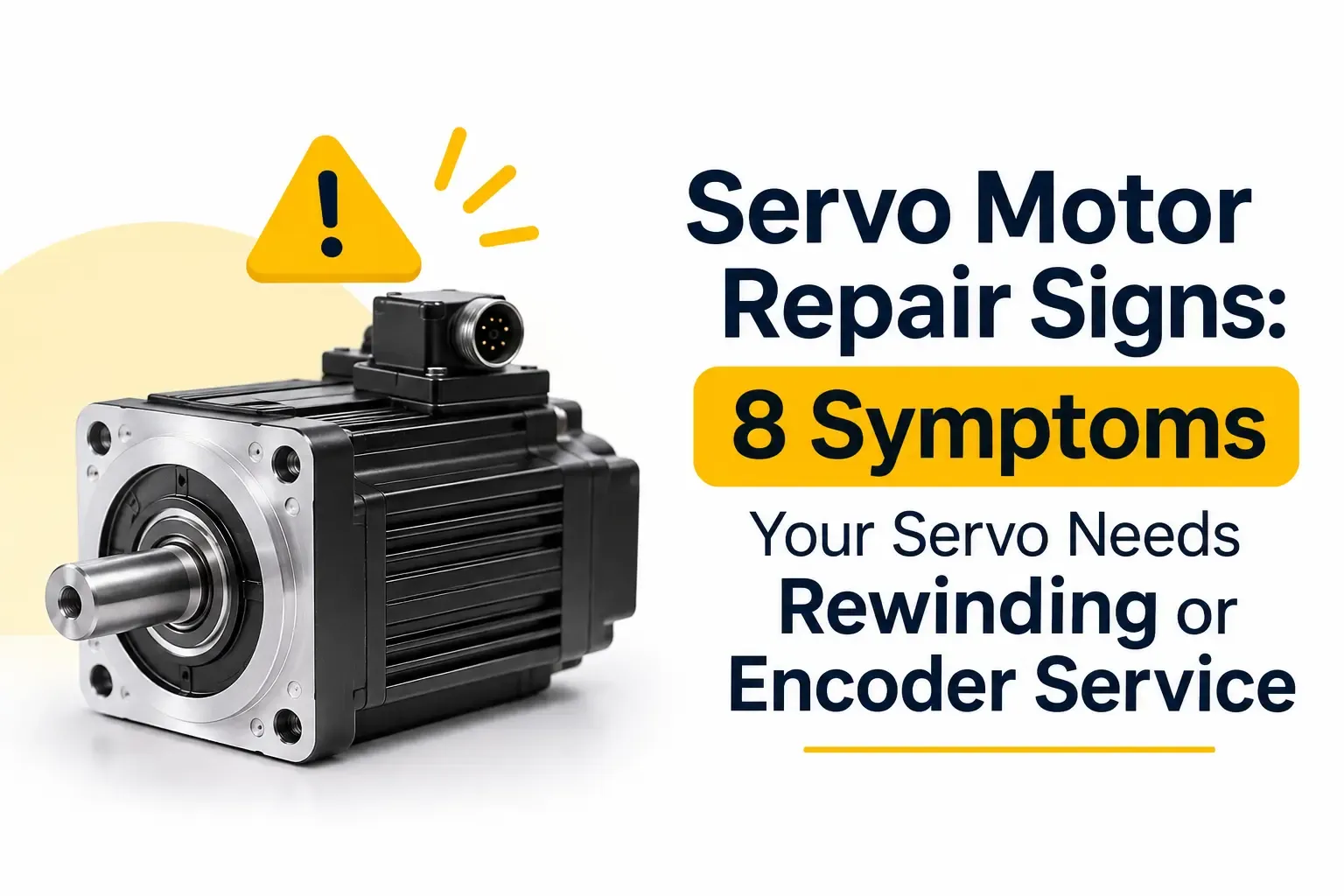
A servo axis rarely fails without warning. It runs hot, hunts for position or trips the drive a little more each week. Then one morning the machine stops.
Most delays in servo motor repair UAE plants deal with come from chasing the wrong fault. The cause could be the drive, the cable, the encoder or the motor windings, and each one needs a different fix.
This guide covers eight clear signs of servo motor failure. For each one, it explains what is likely happening inside the motor and whether it points to rewinding, encoder service or something simpler.
Two Ways a Servo Motor Fails: Winding Side and Feedback Side
A servo motor has two systems that can fail. Knowing which one is at fault saves time and money.
The power side is the stator winding, the insulation around it, the rotor magnets and the bearings. Failures here cause heat, burning smells, ground faults and weak torque. They usually lead to servo motor rewinding or a bearing overhaul.
The feedback side is the encoder or resolver that tells the drive where the shaft is. Failures here cause position errors, jerky motion and axes that drift. They usually lead to servo motor encoder repair.
The two overlap often. A failed encoder can look exactly like a drive fault, and a hot winding can damage the encoder bolted to the same shaft. That is why diagnosis comes before any repair decision.
8 Signs of Servo Motor Failure
1. The Motor Runs Hotter Than Normal
A servo that is too hot to keep a hand on, or that trips on a thermal alarm, is under stress. Several servo motor overheating causes are worth checking:
- An overloaded duty cycle or machine jam
- Shorted turns inside the winding, which raise current and copper losses
- Blocked fins, dust build-up or high ambient heat
- Worn bearings adding friction
- A dragging holding brake
- Over-aggressive drive tuning
Most servo motors use Class F insulation rated to about 155°C. As a common rule of thumb, every 10°C above the rated temperature roughly halves insulation life, so a motor that runs hot for months is ageing quickly.
If the load and cooling are normal and the motor is still hot, suspect the winding. Cabinet and ambient heat also matter in this climate, so see our guide on control panel cooling in UAE heat.
2. A Burning Smell or Discoloured Housing
A burnt varnish smell means the winding insulation has overheated. Dark patches on the housing or a darkened terminal box tell the same story.
Stop running the motor. Insulation damage spreads, and a partly failed winding can short to the frame and damage the drive. This is one of the clearest cases for servo motor rewinding.
3. Ground Fault or Overcurrent Trips
If the drive shows an earth fault, overcurrent or short-circuit alarm, check the motor before you reset again. Repeated resets can damage the drive's output stage.
Disconnect the motor from the drive and test insulation resistance with a megger. A reading well below the manufacturer's minimum points to moisture ingress or breakdown between the winding and the frame. Moisture sometimes dries out with a bake and revarnish. Breakdown needs rewinding.
4. Weak Torque or Unbalanced Winding Resistance
The motor draws high current but produces little torque. It struggles with loads it used to handle easily.
Measure phase-to-phase resistance with a low-resistance meter. The three readings should match closely. A clear imbalance suggests shorted turns or a damaged coil, which a rewind corrects.
5. Jerky Motion, Hunting or Vibration
The axis shudders at low speed, overshoots or hunts around its target position. Tuning is one possible cause. Dirty or damaged encoder discs, noisy feedback signals and poorly shielded cables are others.
If re-tuning does not help and the cable checks out, the encoder is the likely culprit. This is where servo motor encoder repair pays off, because replacing a whole motor to fix a feedback fault is costly.
6. Encoder Alarms, Position Errors and Following-Error Faults
Alarms for encoder communication loss, position deviation or following error are direct signs of feedback trouble. On absolute encoders, a low battery alarm or lost position data points the same way.
Common causes include:
- A damaged or contaminated encoder disc
- Failed electronics inside the encoder
- Cable damage or loose connectors
- Oil, coolant or dust ingress
On CNC axes, the same symptoms can look like a drive failure, so a proper test matters. Our CNC machine repair services cover the controls, drives and feedback systems that these axes depend on.
7. The Axis Drifts, Fails to Hold Position or Runs Away
If a vertical axis sags, the shaft will not hold position or the motor lurches in the wrong direction when enabled, treat it as a safety issue. Lost encoder phasing or a faulty feedback device is the usual cause.
Do not keep enabling the axis to test it. Isolate the machine, then have the feedback system checked and re-phased or repaired.
8. Grinding Noise, Shaft Play or Rough Bearings
Grinding, growling or visible shaft movement means the bearings are wearing out. Left alone, the rotor can rub the stator, and metal dust and grease can reach the encoder and windings.
Bearing replacement is routine in a full servo overhaul, and it is often combined with rewinding or encoder service.
Quick Reference: Symptom, Likely Cause, Likely Fix
- Overheating: overload, shorted turns or poor cooling. Likely fix: load and cooling check, then rewinding if the winding is faulty.
- Burning smell: insulation breakdown. Likely fix: rewinding.
- Ground fault trips: insulation failure or moisture. Likely fix: bake and test, or rewinding.
- Weak torque: shorted turns. Likely fix: rewinding.
- Jerky motion: encoder noise, cable or tuning. Likely fix: encoder service or cable replacement.
- Encoder alarms: feedback failure. Likely fix: encoder repair.
- Drift or runaway: lost phasing or feedback fault. Likely fix: encoder repair and re-phasing.
- Grinding noise: bearing wear. Likely fix: bearing replacement, often with overhaul.
Servo Motor Not Working? Checks to Make Before Removing the Motor
When a servo motor is not working, rule out the simple causes first. Lock out and isolate the machine, and let the drive's DC bus discharge before touching any connection.
- Read the drive alarm history and note every fault code.
- Inspect the power and feedback cables for damage, loose connectors and shield breaks.
- Confirm the brake releases and receives its supply voltage.
- With power off, turn the shaft by hand and note any roughness or binding.
- Check the drive parameters against the motor nameplate.
- If a matching spare is available, swap-test the motor or drive to isolate the fault.
- Test insulation resistance and winding resistance on the motor.
If these checks point to the drive instead, see our article on servo drive repair cost in the UAE for what affects drive repair pricing.
Rewinding, Encoder Service or Replacement: How to Decide
Repair is usually the better choice when the damage is limited to the winding, the encoder or the bearings. It also makes sense for older or discontinued servos where a new unit has a long lead time.
Replacement may be better when the shaft or flange is badly damaged, the rotor magnets are weakened or the repair cost approaches the price of a new motor.
Compare four things before you decide:
- The cost of repair against the cost of a new motor
- Lead time for a replacement unit
- How extensive the damage is
- Whether the machine can stay down while parts arrive
A written diagnostic report makes this comparison straightforward and removes guesswork.
Why UAE Conditions Wear Servo Motors Faster
UAE plants are tough on servo motors. High ambient temperatures, fine dust, humidity near the coast and washdown areas in food plants all shorten insulation and bearing life.
Heat is the main factor. A motor in a hot, unventilated enclosure runs closer to its thermal limit all year. Dust clogs cooling surfaces and gets into encoders. Humidity lowers insulation resistance and invites ground faults.
Regular cleaning, ventilation checks and periodic insulation tests catch most of these problems before they stop production.
What to Expect from a Servo Motor Repair Service in the UAE
A good repair process is documented from the start. At General Tech Automation, our industrial repair services in UAE follow a clear sequence:
- Intake with the make, model, serial number and fault history
- Diagnosis within 24 to 48 hours of arrival, with a written report and quote before any work begins
- Component-level repair and testing under realistic load
- Warranty on completed repairs
Timelines depend on the fault and parts. Our published guidance for industrial repairs is three to five working days for straightforward work, and two to three weeks when imported parts are needed. You can read more about what affects repair turnaround time on industrial electronics.
Our workshop is in Sharjah, and we serve Dubai, Abu Dhabi and the Northern Emirates.
How to Prevent Repeat Servo Failures
Most servo failures build up over time. A planned maintenance routine catches them early.
- Log motor temperature and current trends
- Clean cooling surfaces on a schedule
- Inspect cables and connectors for wear
- Test insulation resistance annually
- Check encoder batteries and signal quality
Plants with many servo axes often move this into a service contract. Our AMC services for panels, VFDs, UPS and servo drives cover scheduled inspections and priority support. To compare options, read what an industrial AMC contract should cover.
Frequently Asked Questions
How do I know if my servo motor is failing?
Watch for overheating, burning smells, ground fault trips, weak torque, jerky motion, encoder alarms, position drift and grinding noise. Any one of these justifies testing the motor before it fails completely.
What causes servo motor overheating?
The most common servo motor overheating causes are overloading, shorted winding turns, poor cooling, high ambient temperature, worn bearings and a dragging brake. If the load and cooling are normal, the winding is the next place to look.
Why is my servo motor not working when the drive shows no fault?
Check the cables, brake supply and encoder connection first. A feedback fault can leave the drive without a clear alarm while the axis behaves badly. If everything checks out, test the motor windings and encoder.
Can a servo motor be rewound, or must it be replaced?
Many servo motors can be rewound when the damage is limited to the winding. Replacement makes more sense when the rotor, shaft or housing is badly damaged, or when repair costs approach a new unit. A diagnostic report settles it.
How long does servo motor repair take in the UAE?
It depends on the fault and parts availability. General Tech Automation diagnoses most repairs within 24 to 48 hours of arrival, and straightforward repairs typically take three to five working days once approved.
Get Your Servo Motor Diagnosed Before It Fails
Early action costs less than an emergency stop. If your servo runs hot, throws encoder alarms or trips the drive, get it tested now.
General Tech Automation provides servo motor repair UAE industries can rely on, with written diagnostics and warranty-backed work. Call +971 6 543 6933 or contact our team for an assessment and quote.